
If you’ve been dealing with chronic back pain, a herniated disc, or radiating leg pain from sciatica, chances are someone has mentioned spinal decompression therapy at some point.
Maybe your doctor brought it up, or you stumbled across it while searching for non-surgical options. Either way, you probably have questions – and one of the most common is: what exactly are the two types of spinal decompression, and how are they different?
That’s exactly what this article is here to answer. We’ll break down both types in plain language, explain how each one works, and help you figure out which might be the right fit for your situation.
What Is Spinal Decompression Therapy?
Before we get into the two types, it helps to understand what spinal decompression actually means in a clinical context. At its core, it refers to any technique that relieves pressure on the spinal discs and the nerves running through or near the spine.
When discs become compressed – whether from age, injury, poor posture, or years of repetitive strain – they can bulge, herniate, or dry out. That pressure causes pain, stiffness, and sometimes nerve symptoms like numbness or tingling that shoot down into your arms or legs.
This treatment category spans both hands-on manual techniques and machine-assisted traction systems. For a more detailed definition, see the definition of spinal decompression therapy (opens in a new tab). It’s worth understanding that the goal, regardless of method, is the same: create space between vertebrae, take pressure off compressed discs and nerves, and allow the body’s natural healing process to do its job.
Now, let’s look at the two primary types.
The Two Types of Spinal Decompression
Surgical Spinal Decompression
Yes, surgery is technically one category of spinal decompression. It’s important to acknowledge this upfront, because when people search for “types of spinal decompression,” they’re often surprised to learn that surgical procedures fall under this umbrella.
Surgical spinal decompression is typically recommended when conservative treatments have failed, when there is severe nerve compression causing significant neurological symptoms (such as progressive weakness or loss of bladder/bowel control), or when imaging reveals structural damage that cannot be managed non-invasively.
There are several surgical procedures that fall into this category:
- Laminectomy: Removal of the lamina (the back part of a vertebra) to create more space in the spinal canal.
- Discectomy: Removal of part or all of a herniated disc that is pressing on a nerve.
- Foraminotomy: Widening of the opening where nerve roots exit the spine.
- Spinal Fusion: Joining two or more vertebrae together to stabilize the spine after decompression.
These procedures are performed under general anesthesia, require recovery time, and carry the risks associated with any major surgery – infection, nerve damage, failed back surgery syndrome, and more. While surgery can be life-changing for the right patient, it is generally considered a last resort when non-surgical options have been exhausted.
Non-Surgical Spinal Decompression Therapy
This is what most patients – and most chiropractors – are referring to when they talk about spinal decompression therapy (opens in a new tab) in a clinical or rehabilitation setting. Non-surgical spinal decompression is a safe, evidence-supported approach that uses controlled mechanical traction to gently stretch the spine, creating negative pressure within the disc.
When that negative pressure is created, a few beneficial things happen. First, bulging or herniated disc material can be drawn back toward its proper position. Second, nutrients, oxygen, and fluids are pulled into the disc, supporting tissue repair. Third, pressure is taken off compressed spinal nerves, which helps reduce pain and restore function.
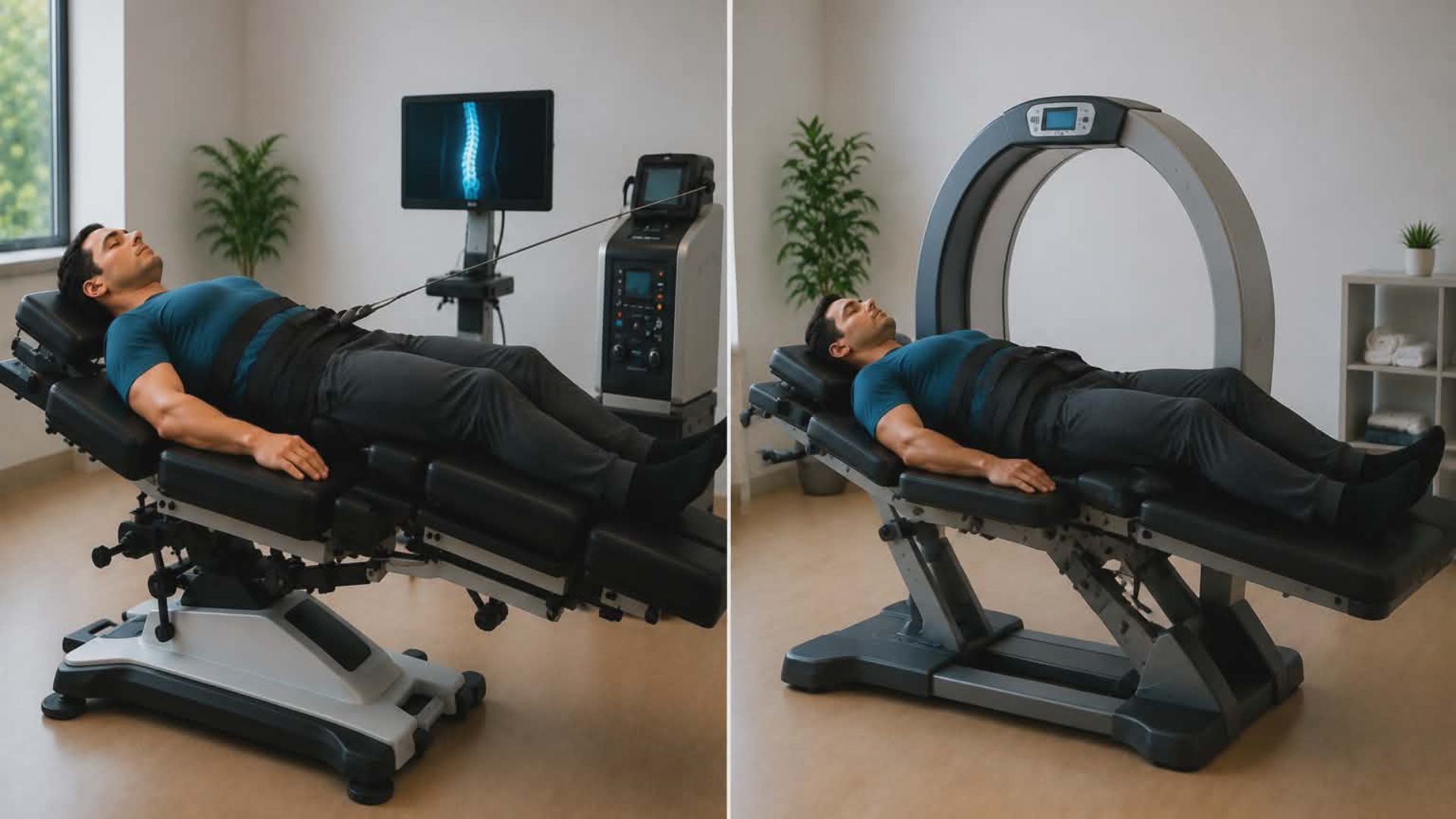
This type of therapy is performed while you’re fully clothed, lying comfortably on a specialized treatment table. There are no incisions, no anesthesia, and no downtime.
Breaking Down Non-Surgical Spinal Decompression: Motorized Traction vs. Manual Techniques
Within non-surgical spinal decompression, there are two main delivery methods worth understanding: motorized (mechanical) traction and manual decompression techniques.
Knowing the difference helps you have a more informed conversation with your provider.
Motorized Spinal Decompression (Table-Based Traction)
This is the most commonly recognized form of non-surgical decompression. It uses a computerized decompression table (brands include DRX9000 and Triton DTS). The patient is secured with a harness around the pelvis or neck, depending on whether the lumbar or cervical spine is being treated.
The table applies a precise, cyclical pulling force that gently elongates the spine. The computer controls the exact amount of distraction force, the angle of the pull, and the duration. This precision matters – it allows the therapy to target specific spinal levels without triggering the muscle guarding reflex that can occur with cruder forms of traction.
Sessions typically last between 30 and 45 minutes. A full treatment protocol often spans several weeks, with sessions scheduled two to five times per week depending on the severity of the condition and how the patient responds.
Conditions commonly treated with motorized spinal decompression include:
- Herniated or bulging discs
- Degenerative disc disease
- Sciatica and lumbar radiculopathy
- Spinal stenosis
- Facet syndrome
- Chronic neck or back pain that hasn’t responded to other treatments
Manual Spinal Decompression Techniques
Manual decompression refers to hands-on techniques performed directly by a chiropractor or physical therapist – without the use of a motorized table. These include specific chiropractic adjustments, the flexion-distraction technique, and certain manual traction methods.
Flexion-Distraction is one of the most well-known manual decompression approaches. It uses a specialized articulating table that allows the clinician to apply a gentle, rhythmic stretching motion to the lumbar spine while simultaneously flexing it. This technique is particularly effective for disc herniations, nerve root compression, and patients who cannot tolerate the supine (lying face up) positioning required by motorized tables.
Manual techniques offer the advantage of real-time clinician feedback – a skilled chiropractor can feel tissue tension, adjust technique on the fly, and combine decompression with soft tissue work, mobilization, or therapeutic exercise within the same session. For some patients, this integrated approach produces faster and more sustainable results than table-based traction alone.
At Elite Chiropractic Rehab & Wellness (opens in a new tab) in Walnut Creek, California, Dr. Ben Rosenstein and Dr. Tony Cresci use a combination of advanced decompression equipment and hands-on techniques, tailoring each treatment plan to the individual patient rather than applying a one-size-fits-all protocol.
How Do You Know Which Type Is Right for You?
Most patients who come in asking about spinal decompression are not surgical candidates – and that’s a good thing. Non-surgical decompression works well for a wide range of spinal conditions, especially when treatment begins before permanent structural damage has occurred.
That said, determining the right type of non-surgical decompression – motorized versus manual, lumbar versus cervical, frequency and duration of care – requires a thorough clinical evaluation.
Your provider will assess your symptoms, review any imaging (X-rays, MRI), and consider your overall health history before designing a treatment plan.
There are also certain situations where spinal decompression is not appropriate, including:
- Pregnancy
- Severe osteoporosis
- Spinal fractures or instability
- Certain types of spinal tumors or infections
- Recent spinal fusion surgery
This is why self-diagnosing and self-treating are never the right approach. A qualified chiropractor or spine specialist can evaluate whether decompression therapy is safe and appropriate for your specific condition.
What to Expect During Non-Surgical Spinal Decompression at a Chiropractic Clinic
If you’ve never had spinal decompression before, it’s natural to wonder what the experience actually feels like. Most patients describe the sensation as a gentle stretching or mild pulling – not painful, and often quite relaxing. Some even fall asleep during the session.
During your first visit, your clinician will walk you through the procedure, position you correctly on the treatment table, and explain how the harness system works. You’ll be monitored throughout the session, and you can communicate any discomfort at any time.
After the session, some patients notice immediate relief. Others experience mild soreness for a day or two as their body adapts – similar to how muscles feel after a new workout. Over a full treatment course, the benefits tend to compound as the disc heals, inflammation decreases, and nerve function improves.
Spinal decompression is rarely used in isolation. Most chiropractic clinics pair it with complementary therapies like cold laser therapy, massage therapy, myofascial release, or rehabilitative exercise to maximize outcomes and support long-term spinal health.
Surgical vs. Non-Surgical: A Quick Comparison
Factor | Surgical Decompression | Non-Surgical Decompression
|
|---|---|---|
Invasiveness | High (requires incisions, anesthesia) | None |
Recovery Time | Weeks to months | Little to none |
Risk Level | Higher (surgical complications) | Very low |
Cost | Significantly higher | More affordable |
Candidate Type | Severe, unresponsive cases | Mild to moderate disc and nerve conditions |
Setting | Hospital or surgical center | Chiropractic or PT clinic |
For most patients experiencing back pain, sciatica, or disc issues, the non-surgical route is the appropriate starting point – and for many, it’s the only route they’ll ever need.
Frequently Asked Questions
Is non-surgical spinal decompression the same as regular traction?
Not exactly. Traditional traction applies a steady pulling force, which can actually trigger muscle guarding and limit effectiveness. Modern motorized decompression tables use a gradual build-and-release pull pattern, which prevents muscles from tensing and lets the disc decompress more fully.
How many sessions of non-surgical decompression does it take to see results?
Most patients begin noticing improvement within the first few sessions, though a complete treatment course usually involves 15 to 30 visits over four to eight weeks. Your provider will reassess your progress regularly and adjust the plan as needed.
Can spinal decompression be combined with other therapies?
Absolutely, and it often should be. Combining decompression with soft tissue therapies, corrective exercise, and supportive modalities like cold laser therapy tends to produce better long-term outcomes than decompression alone. This is part of what makes the comprehensive care model at a place like Elite Chiropractic Rehab & Wellness so effective.
Is non-surgical spinal decompression covered by insurance?
Coverage varies depending on your insurance plan and provider. Some plans cover certain forms of traction or chiropractic care, while others do not cover motorized decompression specifically. It’s worth calling your insurance provider or asking the clinic to verify your benefits before beginning treatment.
The Bottom Line
Understanding the two types of spinal decompression therapy – surgical and non-surgical – helps you make more informed decisions about your spinal health. For the vast majority of people dealing with disc-related pain, nerve compression, or chronic back and neck issues, non-surgical decompression is the smarter first step: it’s safe, effective, non-invasive, and increasingly supported by clinical research.
If you’re in the Walnut Creek area and wondering whether spinal decompression therapy is right for you, the team at Elite Chiropractic Rehab & Wellness is here to help. Drs. Rosenstein and Cresci offer thorough evaluations, honest recommendations, and personalized treatment plans designed around your goals – not a generic protocol.
You don’t have to keep managing pain on your own. Call Elite Chiropractic Rehab & Wellness (opens in a new tab) at 925-476-5070 or visit us to schedule a consultation and take the first step toward a stronger, pain-free spine.