If you’ve been told you have a disc extrusion, you’re probably navigating a wave of confusing medical terms, conflicting advice, and a very real question: do you actually need surgery? The good news is that research increasingly supports non-surgical options, and spinal decompression therapy is one of the most studied among them.
This article breaks down what the science actually says, without the medical jargon overload.
What Is a Disc Extrusion, Exactly?
Your spinal discs act as shock absorbers between the vertebrae. Each disc has a tough outer layer called the annulus fibrosus and a gel-like center called the nucleus pulposus. A disc extrusion happens when the inner gel pushes all the way through the outer layer but remains connected to the disc itself.
This is more severe than a standard herniation. The extruded material can press directly on nearby nerves, causing radiating pain, numbness, tingling, or weakness, often into the legs or arms depending on where in the spine it occurs.
Many people assume that a disc extrusion automatically means surgery. But that assumption is being challenged by a growing body of clinical evidence.
Why Spinal Decompression Therapy Is Being Studied for This Condition
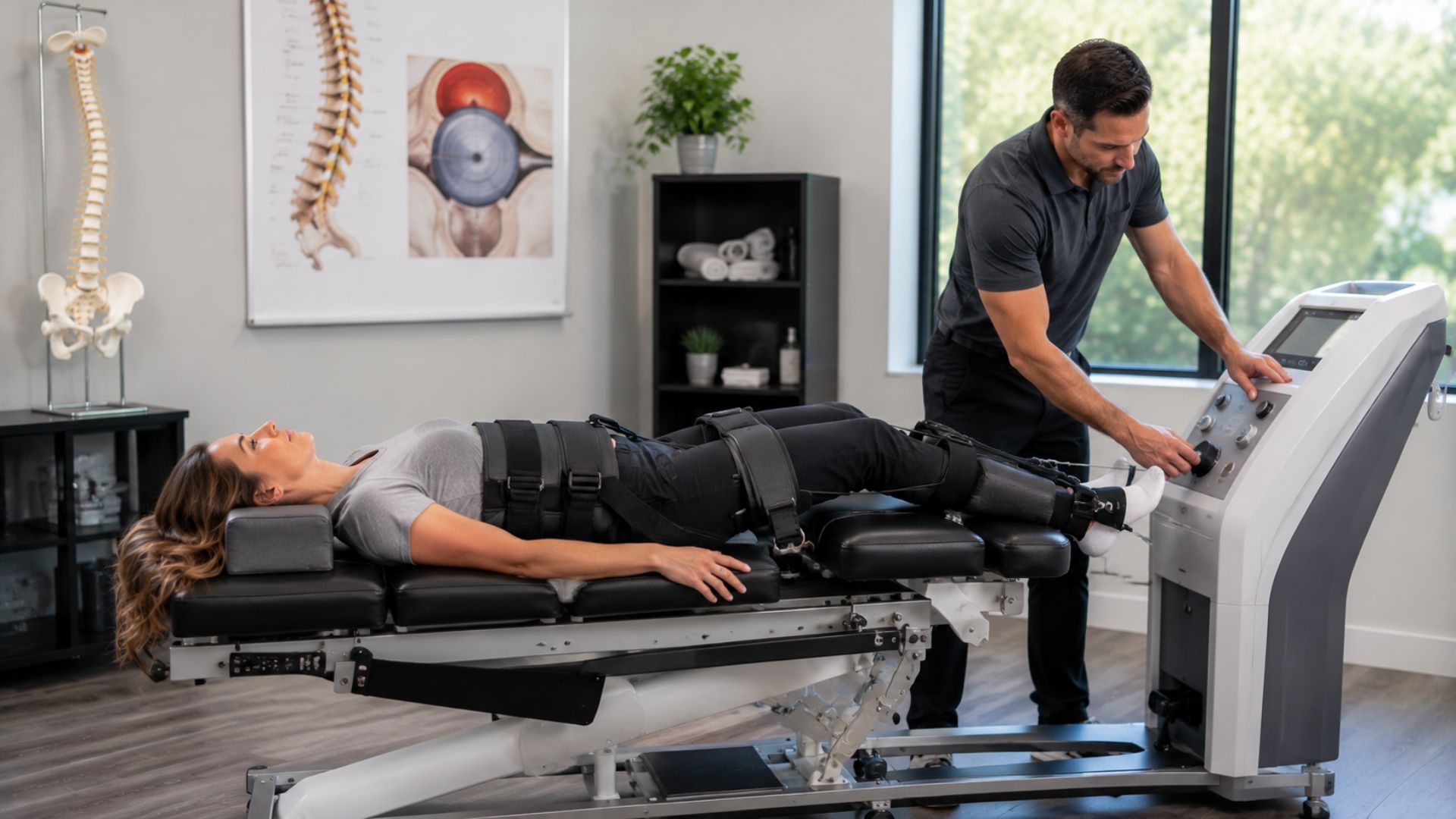
Non-surgical spinal decompression uses motorized traction to gently stretch the spine in a controlled, intermittent pattern. This creates a negative intradiscal pressure – essentially a gentle vacuum effect inside the disc – that may draw herniated or extruded material back toward its original position and promote the inflow of oxygen and nutrients.
It sounds almost too simple, but the physics behind it is well-supported. When disc pressure drops significantly, the conditions change inside the spinal segment in a way that can reduce nerve compression and encourage tissue healing.
Researchers have been particularly interested in whether this mechanism translates to real clinical outcomes for patients with disc extrusions, not just mild herniations.
What the Clinical Research Actually Shows
Reduction in Disc Size and Nerve Compression
One of the more compelling findings in the research involves imaging outcomes. Several studies using MRI follow-up have documented measurable reductions in disc protrusion or extrusion size following a course of non-surgical decompression therapy.
A notable study published in the Journal of Neuroimaging examined patients with lumbar disc herniations and extrusions who underwent a structured decompression protocol. Results showed a significant reduction in disc herniation size, and the majority of patients reported meaningful pain relief alongside those imaging changes. This matters because it suggests the therapy isn’t just masking pain – it may be addressing the structural issue contributing to it.
Pain Relief Outcomes
Pain reduction is consistently reported across multiple studies examining spinal decompression for disc-related conditions. A clinical trial involving patients with chronic low back pain linked to disc pathology found that decompression therapy produced statistically significant improvements in pain scores compared to control groups receiving more passive treatments.
Importantly, researchers have noted that outcomes tend to be most favorable when decompression is combined with complementary care, such as exercise rehabilitation, soft tissue work, or chiropractic adjustments. This reflects the reality that disc extrusions don’t happen in isolation; the surrounding muscles, joints, and movement patterns all play a role in recovery.
Functional Improvement and Return to Activity
Pain scores alone don’t tell the full story. A number of studies have tracked functional outcomes – meaning how well patients can move, work, and live their lives. Here, too, decompression therapy shows a meaningful advantage over purely passive rest or medication-based management.
Patients who complete a full course of decompression therapy typically report improvements in their ability to walk, sit, and perform daily tasks. For active individuals – athletes, parents, professionals who can’t afford to be sidelined – this functional recovery matters just as much as pain relief.
What the Research Doesn’t Say
It’s worth being honest here. Not every study on spinal decompression is methodologically perfect. Some earlier research had small sample sizes or lacked strong control groups. The scientific community continues to call for larger, randomized controlled trials to build a more definitive evidence base.
That said, the current body of literature, when taken together, consistently points in a favorable direction. And critically, spinal decompression therapy has a strong safety profile. Adverse effects are rare when the therapy is properly administered by a trained clinician who has reviewed the patient’s imaging and history.
Surgery carries its own risks: infection, anesthesia complications, failed back surgery syndrome, and extended recovery times. For many patients with disc extrusions, the risk-benefit comparison makes a trial of conservative care, including decompression therapy, a logical and evidence-supported first step.
Who Is a Good Candidate?
Research suggests the best candidates for spinal decompression therapy in cases of disc extrusion tend to share a few common characteristics. They have confirmed disc pathology on imaging; they don’t have severe neurological compromise (such as progressive muscle weakness or loss of bladder and bowel control, which require urgent surgical evaluation), and they haven’t found adequate relief through standard conservative measures alone.
Age, fitness level, and the duration of symptoms can also influence outcomes. Some studies suggest that patients who seek decompression care earlier in the course of their condition, rather than after months or years of failed treatments, tend to respond more favorably.
If you’re unsure whether you’re a candidate, a thorough clinical evaluation by an experienced provider is the right starting point. At Elite Chiropractic Rehab & Wellness (opens in a new tab), Dr. Ben Rosenstein and Dr. Tony Cresci review each patient’s imaging, history, and functional limitations before recommending any treatment path. The goal is always to match the right therapy to the right person, not to apply a one-size-fits-all protocol.
How Decompression Fits Into a Broader Recovery Plan
One thing the research makes clear is that decompression therapy works best as part of a comprehensive approach. At ECRW, spinal decompression is often paired with chiropractic care (opens in a new tab), myofascial release, targeted rehabilitation exercises, and other modalities like cold laser therapy or massage, depending on what the patient needs.
This integrated model aligns with what the clinical literature recommends. Disc extrusions affect not just the disc itself but the entire movement system around it. Treating only one piece of the puzzle rarely produces lasting results.
For a deeper look at the evidence and how outcomes compare across patient groups, the success rate (opens in a new tab) of spinal decompression therapy page offers additional context worth reviewing.
A Condition Worth Taking Seriously – But Not Panicking Over
Disc extrusion sounds alarming. And it is a legitimate structural problem that deserves proper attention. But the research tells us that it is not automatically a surgical problem, and for many patients, a well-designed non-surgical plan produces outcomes that are comparable to or better than surgery, without the associated risks or recovery burden.
According to the American Academy of Orthopaedic Surgeons, the majority of patients with lumbar disc problems improve with conservative treatment over time – a finding that supports giving non-surgical options a serious, structured chance before escalating to more invasive interventions.
The Bottom Line
The science on spinal decompression therapy for disc extrusion is encouraging and growing. If you’re dealing with this condition and looking for a research-informed, non-surgical path forward in Walnut Creek or the greater Bay Area, call Elite Chiropractic Rehab & Wellness at 925-476-5070 to schedule an evaluation (opens in a new tab). The team will take the time to understand your specific situation and determine whether decompression therapy is the right fit for your recovery.