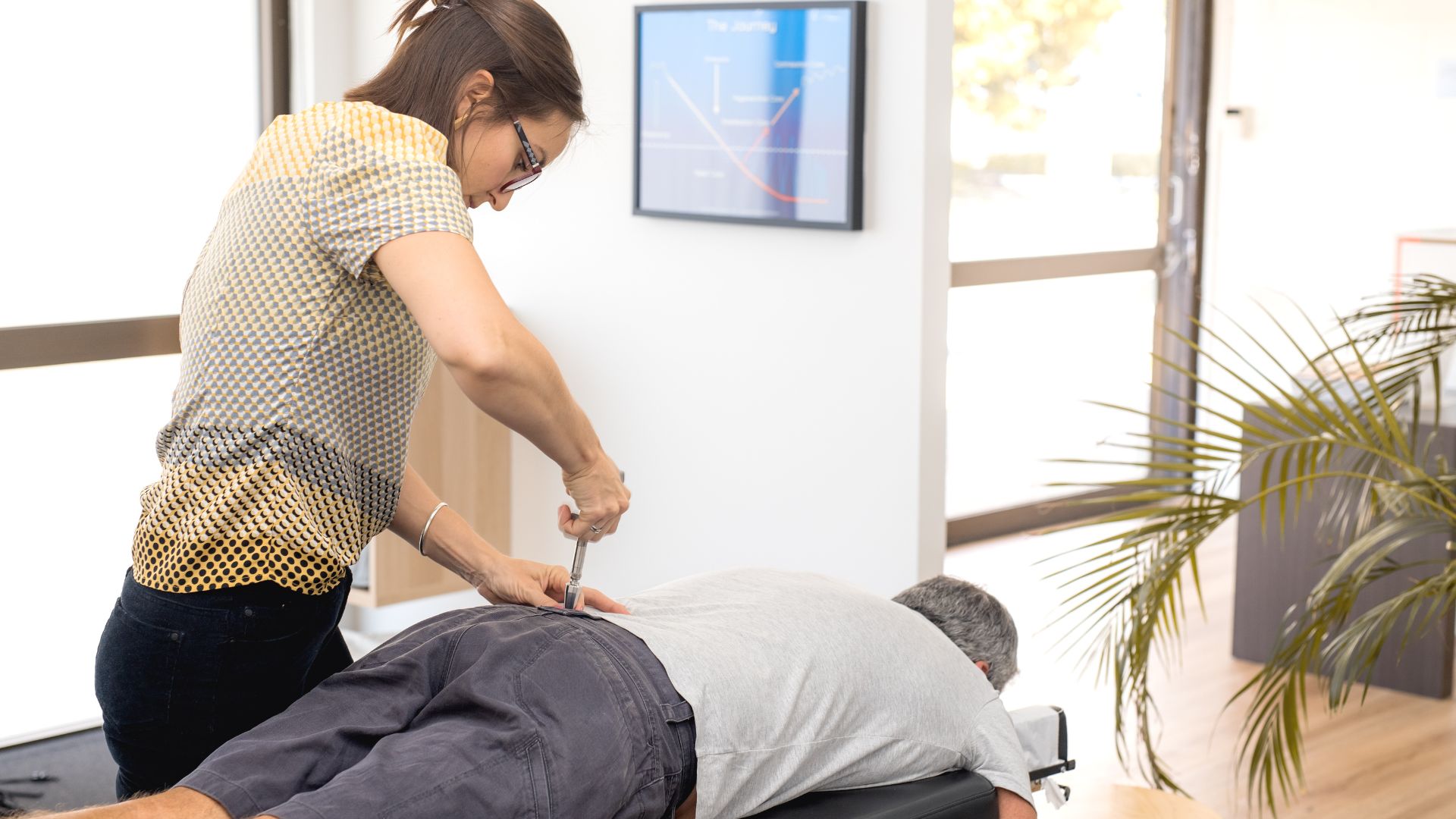
If you’ve been told you have a bulging disc, your first reaction was probably something like: “That sounds serious. Do I need surgery?” The good news is that most people with this condition do not end up on an operating table. In fact, a chiropractic adjustment can play a meaningful role in reducing pain, restoring mobility, and helping the body heal without invasive intervention.
Let’s break down what’s actually happening in your spine, and why chiropractic care makes sense as a first-line approach.
What Is a Bulging Disc, Exactly?
Your spinal column is made up of vertebrae stacked on top of each other, with intervertebral discs sitting between them. These discs act like shock absorbers – soft on the inside, tougher on the outside. When a disc bulges, the outer layer pushes outward beyond its normal boundary. It hasn’t ruptured (that would be a disc herniation (opens in a new tab)), but it’s under enough stress to cause real problems.
When that bulging tissue presses against a nearby spinal nerve or the spinal cord itself, you can experience pain, numbness, tingling, or weakness – sometimes in your back, sometimes radiating down your leg or arm depending on which part of the spine is affected. Lumbar (lower back) and cervical (neck) discs are the most commonly involved.
The pain can range from a dull ache to sharp, burning discomfort. Muscle spasms often accompany this pain as the surrounding muscles tighten protectively around the affected area.
How Does a Chiropractic Adjustment Help?
This is where a lot of people get confused. If the disc is pressing on a nerve, how does adjusting the spine help?
Restoring Alignment Reduces Pressure
When vertebrae are misaligned – even slightly – they can shift the load onto a disc unevenly, increasing pressure at a specific point. A spinal adjustment, also called spinal manipulation, works to realign those vertebrae. When the joint moves back toward its proper position, the uneven pressure on the disc decreases. Less pressure means less irritation on the surrounding nerve tissue.
Think of it like a door that’s slightly off its hinges. The frame takes the strain unevenly. Fix the hinge, and the stress is distributed properly again.
Reducing Inflammation and Muscle Tension
Chiropractic treatment techniques are not just about cracking joints. Adjustments also influence the surrounding soft tissue, promote better circulation, and can reduce local inflammation. This matters because inflammation is often a major driver of pain in disc-related conditions.
When the inflammatory response is calmed, the muscle spasm that accompanies it tends to ease as well. Patients frequently report that their pain and stiffness improve noticeably after even a few sessions of chiropractic care – not because the disc magically disappeared, but because the whole mechanical and neurological environment around it has changed.
Improving Joint Mobility
When you’re in pain, your body naturally guards the area. You move less, you stiffen up, and that decreased movement can make things worse over time. Regular spinal adjustment helps restore range of motion to restricted joints. Better mobility means less chronic tension, which supports the disc’s ability to receive nutrients and begin healing.
Is Chiropractic Care Safe for a Bulging Disc?
This is a fair question. Research indexed by the National Library of Medicine supports spinal manipulation as a reasonable, evidence-based approach for appropriate patients.
Of course, not every technique is right for every patient. A skilled chiropractor (opens in a new tab) will perform a thorough assessment (opens in a new tab) – sometimes including a review of magnetic resonance imaging (MRI) results – before determining which approach is best. Certain cases, particularly those involving spinal cord compression or significant neurological deficits, may require a different pathway.
At Elite Chiropractic Rehab & Wellness, every treatment plan starts with understanding the full picture of what’s happening in your spine.
The Role of Spinal Decompression Therapy
For patients with a more stubborn or significant bulging disc (opens in a new tab), chiropractic adjustment is often paired with spinal decompression therapy (opens in a new tab). This is a non-surgical form of traction (opens in a new tab) that gently stretches the spine to create negative pressure inside the disc.
That negative pressure does something remarkable – it can draw the bulging disc material back toward the center while also encouraging oxygen, water, and nutrients to flow back into the disc. This supports actual tissue healing rather than just symptom management.
Spinal decompression is particularly effective for patients dealing with degenerative disc disease, lumbar disc injuries, or pain that radiates into the leg – a pattern often associated with nerve involvement. It’s a treatment that targets the root cause rather than masking symptoms with medication like nonsteroidal anti-inflammatory drugs, corticosteroids, or analgesics.
What Else Is Involved in Effective Disc Care?
Chiropractic treatment rarely works best in isolation. A comprehensive approach to managing a bulging disc often includes several supportive therapies.
Soft Tissue Work and Massage
Myofascial release and massage therapy address the muscles and connective tissue around the affected area. When a disc is injured, the surrounding skeletal muscle often tightens protectively – sometimes for so long that the tension itself becomes a chronic condition. Releasing that tension directly supports recovery.
Rehabilitation Exercises
Rebuilding strength and stability around the lumbar vertebrae or cervical vertebrae – depending on where your disc issue is located – is essential for long-term health. Exercise and physical therapy help correct poor spinal posture, reduce pelvic tilt imbalances, and prevent re-injury. Muscles that are strong and well-coordinated protect the disc from repeated stress.
Cold Laser Therapy
Also known as red light therapy, this modality uses specific light wavelengths to reduce inflammation and promote cellular repair in injured tissue. For patients who are sensitive to hands-on treatment, this can be a gentle but effective complement to adjustment and decompression.
Signs That a Bulging Disc May Be More Serious
Knowing when to seek help promptly is important. While most bulging disc cases respond well to conservative care, certain signs and symptoms warrant urgent attention. These include loss of bladder or bowel control, significant leg weakness, or rapidly progressing numbness. These may indicate more serious spinal cord involvement and should be evaluated immediately.
For the large majority of patients, though, a bulging disc does not lead to disability or require orthopedic surgery. With the right care plan, most people recover well and return to an active, pain-free life.
Why Early Care Matters
Delaying treatment for a bulging disc tends to make things harder, not easier. Chronic pain develops when the nervous system stays sensitized for too long. Muscle imbalances deepen. The disc may undergo further degenerative changes. Starting chiropractic care early – before the problem becomes chronic – gives the body its best opportunity to heal with minimal intervention.
Waiting to see if the pain goes away on its own is sometimes appropriate, but if pain persists beyond a few weeks, is worsening, or is affecting your sleep and daily function, that’s a clear signal to get evaluated.
Taking the Next Step for a Bulging Disc
A bulging disc doesn’t have to mean surgery, long-term medication, or accepting chronic back pain as your new normal. Chiropractic adjustment works by reducing pressure on the affected disc, restoring proper joint movement, calming inflammation, and supporting the body’s natural healing process. When combined with therapies like spinal decompression, massage, and targeted rehabilitation, results are meaningful and lasting.
If you’re ready to take the next step toward a pain-free life, learn more about spinal decompression therapy (opens in a new tab) at Elite Chiropractic Rehab & Wellness (opens in a new tab) or call us at 925-476-5070 to schedule your evaluation.