If you’ve been living with severe chronic low-back pain, you’ve probably already tried the basics – rest, over-the-counter pain relievers, maybe even physical therapy. And if you’re still hurting, you’re likely asking a more pointed question: What actually works?
Two of the most effective non-surgical options available today are chiropractic care and spinal decompression therapy. Both are commonly offered together, but they work differently, and understanding which one is better suited to your condition can make a real difference in your recovery.
Let’s break it down honestly.
What Is Chiropractic Care, and How Does It Help Low-Back Pain?
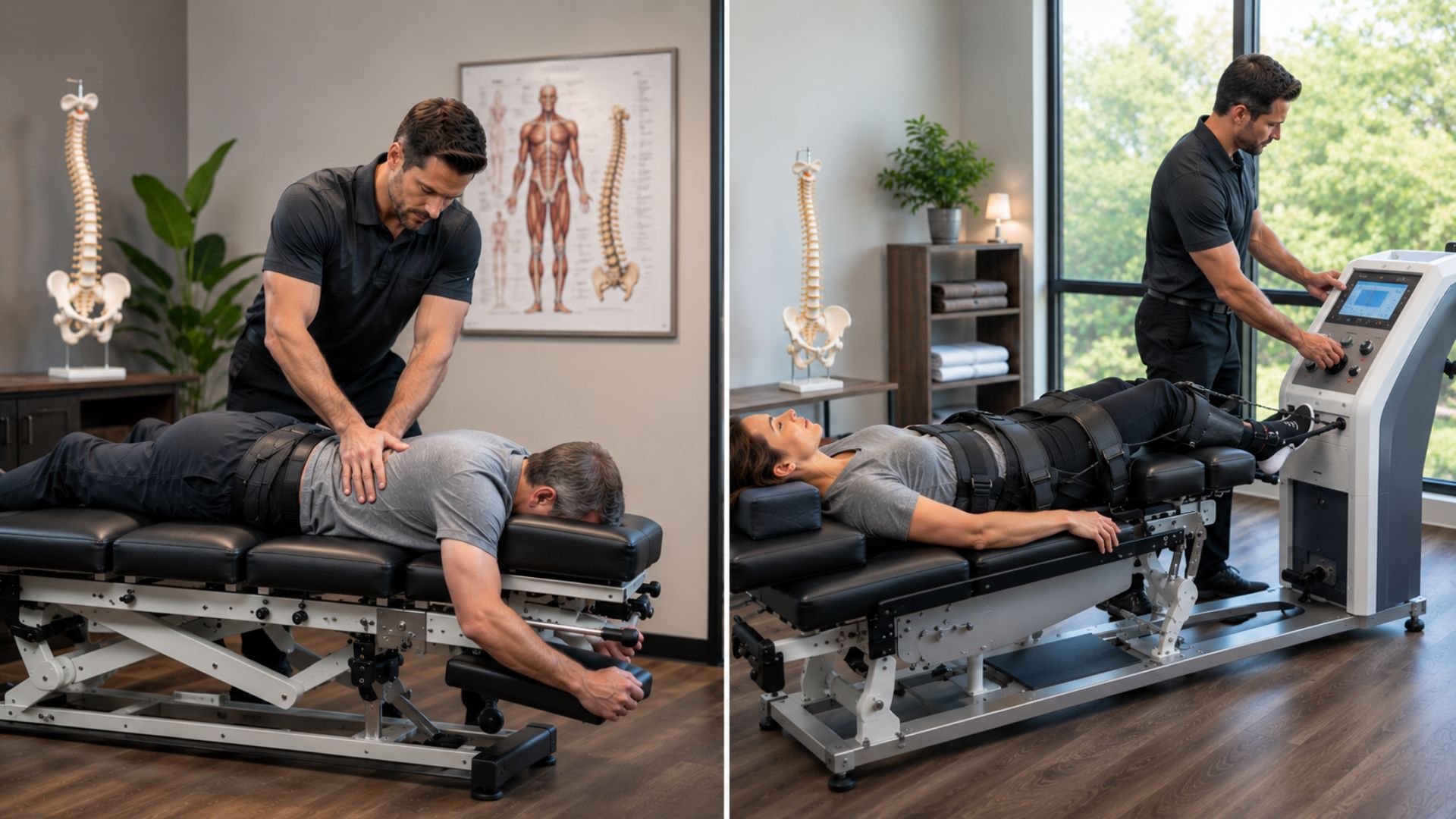
Chiropractic care is built around one core idea: when the spine is properly aligned and moving the way it should, the body is far better equipped to heal itself. A chiropractor uses hands-on spinal manipulation – along with soft tissue techniques, mobilization, and rehabilitative exercises – to restore normal function to the spine and surrounding structures.
For chronic low-back pain, this approach is particularly valuable because poor spinal mechanics often sit at the root of the problem. Years of sitting, repetitive strain, old injuries, or postural habits can lock up spinal joints and create compensatory patterns that lead to persistent pain. Chiropractic care targets those dysfunctional movement patterns directly.
Research consistently supports its effectiveness. According to a systematic review (opens in a new tab) published in JAMA Internal Medicine, spinal manipulation is associated with significant improvements in both pain and function for acute and chronic low-back pain patients, with a modest but clinically meaningful effect size.
What Conditions Does Chiropractic Care Work Best For?
Chiropractic care tends to shine when the pain is driven by joint dysfunction, muscle imbalance, or postural strain. It’s especially effective when:
- The pain is mechanical in nature (meaning it changes with movement or position)
- Muscle tightness, spasms, or stiffness are contributing factors
- The patient needs active rehabilitation alongside passive treatment
- Pain is recurring due to poor movement patterns or lifestyle habits
If your lower back hurts after a long day at the desk or after physical activity – and you notice it getting better or worse depending on how you move – chiropractic care is likely a strong fit.
What Is Spinal Decompression Therapy, and When Is It the Better Choice?
Spinal decompression therapy (opens in a new tab) works on a fundamentally different mechanism. Rather than restoring joint motion through manipulation, it gently stretches the spine using a motorized traction table to create negative pressure within the spinal discs.
That negative pressure does something mechanical manipulation typically cannot: it creates a vacuum-like effect inside the disc that pulls herniated or bulging disc material back toward the center, while simultaneously drawing in oxygen, fluids, and nutrients that promote healing. For patients dealing with disc-specific problems, this can be a genuine game-changer.
This is why spinal decompression therapy is often considered the stronger option for conditions like:
- Herniated or bulging discs causing radiating leg pain or sciatica
- Degenerative disc disease, where disc height and hydration have been lost over time
- Spinal stenosis with associated nerve compression
- Chronic radiculopathy – nerve pain that travels down the leg
If your low-back pain is accompanied by shooting, burning, or numbness down one or both legs, that’s a signal the problem may be disc-related or neurological in origin – and spinal decompression therapy may be the more targeted solution.
Chiropractic Care vs. Spinal Decompression: Key Differences at a Glance
Factor | Chiropractic Care | Spinal Decompression
|
|---|---|---|
Primary mechanism | Joint manipulation and mobilization | Negative disc pressure via traction |
Best for | Mechanical back pain, joint dysfunction | Disc herniations, nerve compression |
Technique | Hands-on, active | Table-assisted, passive |
Addresses nerve symptoms | Indirectly | Directly |
Rehab component | Yes, often integrated | Can be paired with chiropractic |
The table above isn’t meant to declare a winner – because for most patients with severe chronic low-back pain, the real answer is that these two treatments work best together.
Why the “Either/Or” Question Misses the Point
Here’s the honest answer most people aren’t told: for severe, chronic low-back pain, combining chiropractic care with spinal decompression therapy is typically more effective than choosing one over the other.
Chronic low-back pain is rarely caused by a single problem. Most patients have some degree of joint dysfunction, disc involvement, and muscle compensation. Treating only one piece of that puzzle leaves the others unaddressed.
At Elite Chiropractic Rehab & Wellness (opens in a new tab) in Walnut Creek, Dr. Ben Rosenstein and Dr. Tony Cresci take a comprehensive look at the full clinical picture before deciding on a treatment approach. That might mean starting with spinal decompression to address disc pressure and nerve irritation, then layering in chiropractic adjustments to restore joint mobility, and supporting it all with soft tissue work, rehabilitation exercises, or complementary therapies like cold laser therapy.
That integrated approach is what separates real results from temporary relief.
How to Know Which Treatment You Actually Need
A fair assessment starts with a proper clinical evaluation – not a quiz on the internet. That said, there are some useful patterns worth considering.
You may benefit more from chiropractic care if your pain is largely mechanical, meaning it’s clearly affected by movement, posture, or activity. If you feel better after walking and worse after sitting still, your spine likely needs improved motion and alignment more than anything else.
You may benefit more from spinal decompression therapy if you have persistent radiating pain, tingling, or weakness in the legs – especially if imaging has confirmed a disc herniation or significant degeneration. These structural problems often don’t respond as well to manipulation alone because the root cause is inside the disc, not just in the joints around it.
And if you’ve had chronic back pain for years without clear relief from any single treatment, the combination approach is almost certainly worth exploring.
What to Expect at a Clinic That Offers Both
When a clinic offers both chiropractic care and spinal decompression, as ECRW does, you have the advantage of being assessed holistically rather than funneled toward a single service.
At your initial visit, you’ll typically undergo a thorough history, postural and movement assessment, and neurological screening. Based on those findings, your providers will map out a personalized treatment plan with clear goals and realistic timelines.
Sessions are generally non-invasive and well-tolerated. Spinal decompression involves lying on a specialized table while gentle traction cycles work on the disc. Chiropractic adjustments are precise and targeted. Many patients report noticeable improvement within the first few weeks of consistent care.
If you want to understand exactly what’s involved before committing, it helps to review the benefits and process of spinal decompression therapy (opens in a new tab) so you know what to expect going in.
Which Treatment Fits Your Back Pain Best?
There’s no universal winner between chiropractic care and spinal decompression therapy. What matters is identifying the true source of your chronic low-back pain and matching the treatment to that cause.
If the pain is mechanical, chiropractic care may be your primary tool. If disc pathology or nerve compression is involved, spinal decompression gives you something manipulation simply can’t replicate. And if your situation involves both – which it often does after years of chronic pain – combining the two is where most patients find lasting relief.
If you’ve been dealing with severe low-back pain and want to know which approach is right for your specific case, call Elite Chiropractic Rehab & Wellness at 925-476-5070 to schedule a thorough evaluation with Dr. Rosenstein or Dr. Cresci (opens in a new tab). Getting the right answer starts with getting properly assessed.