If you’ve been dealing with back pain, sciatica, or a herniated disc, you’ve probably heard about both spinal decompression therapy and chiropractic care. Maybe you’ve even wondered which one you should try first or whether you need both at all.
Here’s the honest answer: for most people, using these two therapies together produces significantly better results than either one alone. And once you understand why, it starts to make a lot of sense.
Two Different Tools, One Shared Goal
Spinal decompression and chiropractic adjustments are not the same thing, but they complement each other remarkably well.
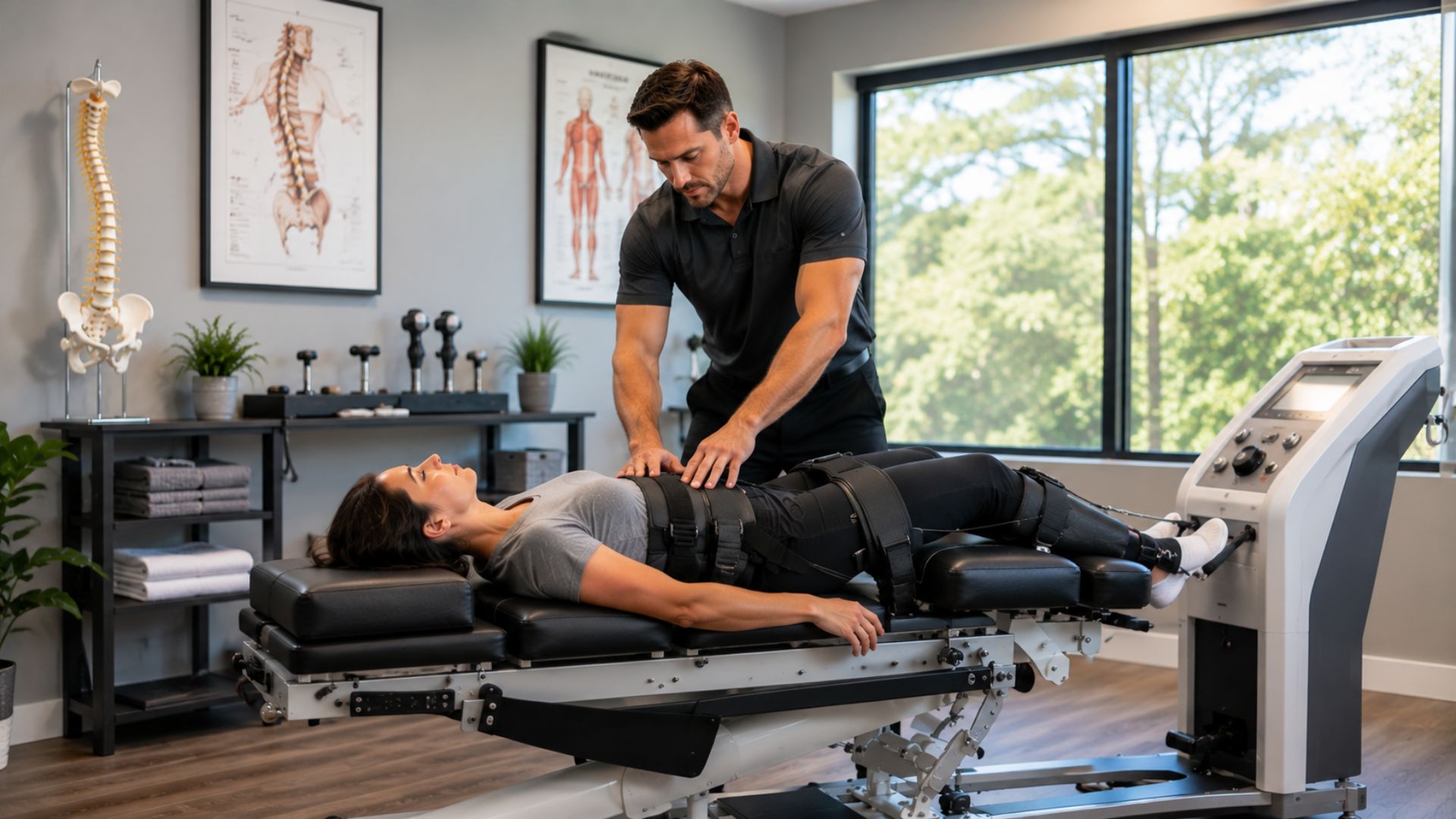
Spinal decompression therapy (opens in a new tab) works by gently stretching the spine using a motorized traction table. This creates negative pressure inside the spinal discs, which helps retract herniated or bulging disc material and encourages nutrients, oxygen, and fluids to flow back into damaged areas. It’s a targeted, mechanical approach to relieving disc-related pressure.
Chiropractic care (opens in a new tab), on the other hand, focuses on restoring proper alignment and joint mobility throughout the spine. A chiropractor uses precise manual adjustments to correct vertebral misalignments, called subluxations, that restrict movement and interfere with nerve function.
When you combine both, you’re addressing the problem from two angles: decompression relieves disc pressure and promotes healing from within, while chiropractic adjustments ensure the spine is properly aligned so that healing can hold.
Why Spinal Decompression Alone Isn’t Always Enough
Spinal decompression is highly effective on its own. Research has consistently shown it can reduce disc herniation, relieve nerve compression, and decrease chronic lower back pain. But there’s a catch.
If your spine is misaligned before or after decompression, the joints surrounding the affected disc may still be locked up or moving incorrectly. That means the relief you get from decompression may be shorter-lived, because the structural issues driving the problem haven’t been fully addressed.
Think of it like inflating a tire on a car with poor wheel alignment. The tire may hold air fine, but the underlying alignment problem will cause it to wear unevenly again. Chiropractic adjustments help correct that structural foundation so the benefits of decompression last longer.
Why Chiropractic Adjustments Alone May Fall Short for Disc Issues
Chiropractic care is excellent for restoring spinal motion, reducing nerve interference, and managing a wide range of musculoskeletal conditions. But in cases involving significant disc herniation, degenerative disc disease, or severe nerve compression, manual adjustments may only go so far.
Adjustments can improve joint mobility and reduce surrounding muscle tension, but they don’t directly create the negative intradiscal pressure needed to pull a herniated disc back toward its center. That’s where spinal decompression fills the gap.
For patients with disc-related pain, combining chiropractic care with decompression therapy means you’re treating both the joints and the discs simultaneously. That’s a more complete approach to recovery.
How the Two Therapies Support Each Other
When used as part of a coordinated treatment plan, spinal decompression and chiropractic care reinforce each other in very practical ways.
- Decompression prepares the spine for adjustment. After a decompression session, the muscles and soft tissues around the spine are often more relaxed and pliable. This can make chiropractic adjustments easier to perform and more effective, since tension in the surrounding tissue isn’t working against the adjustment.
- Chiropractic care helps maintain decompression gains. Once decompression has created space and improved disc health, chiropractic adjustments help keep the vertebrae properly positioned so that disc pressure doesn’t return as quickly. Proper alignment encourages the healing environment that decompression works hard to create.
- Together, they address both the structural and neurological components of pain. Many patients dealing with back pain or sciatica are experiencing nerve irritation caused by a combination of disc compression and joint dysfunction. Targeting both at the same time tends to produce faster, more durable relief.
Conditions That Respond Well to Combined Care
This integrated approach tends to be especially valuable for people dealing with:
- Herniated or bulging discs in the lumbar or cervical spine
- Sciatica caused by disc compression or lumbar joint dysfunction
- Degenerative disc disease with overlapping joint stiffness
- Chronic lower back pain that hasn’t responded well to single-modality care
- Neck pain with radiating symptoms into the arms or shoulders
That said, not everyone is a candidate for spinal decompression. Patients with certain conditions, including fractures, osteoporosis, spinal fusions, or pregnancy, may not be suitable for this therapy. A proper evaluation always comes first.
What to Expect From an Integrated Treatment Plan
At Elite Chiropractic Rehab & Wellness (opens in a new tab), patients receiving both therapies typically go through a structured, progressive plan. The sequence and frequency of each treatment are tailored to the individual – there’s no one-size-fits-all protocol.
Early in treatment, sessions may lean more heavily on decompression to reduce acute disc pressure and calm nerve irritation. As the spine begins to stabilize, chiropractic adjustments play a larger role in restoring normal joint mechanics and maintaining alignment.
Depending on the patient’s condition and goals, the care plan may also incorporate complementary therapies like cold laser (opens in a new tab), myofascial release (opens in a new tab), or massage to further support tissue healing and reduce inflammation. The goal is always to get patients moving better and feeling better as efficiently as possible, without relying on medication or surgery.
Progress is monitored throughout, and the plan adjusts based on how the patient responds.
This is evidence-based care, not a cookie-cutter approach.
Frequently Asked Questions
Is it safe to do spinal decompression and chiropractic adjustments on the same day?
In many cases, yes. Experienced clinicians can often sequence both treatments within the same visit in a way that maximizes benefit. The order and approach depend on the patient’s condition and how their body is responding.
How many sessions does it take to see results?
Results vary by condition and severity, but many patients begin to notice meaningful improvement within the first few weeks of consistent treatment. Chronic cases typically require a longer course of care.
Can this approach help avoid surgery?
For many patients, yes. Non-surgical spinal decompression combined with chiropractic care has helped a significant number of people avoid invasive procedures. However, this depends on the nature and severity of the underlying condition, which is why a thorough clinical evaluation is essential before starting treatment.
The Bigger Picture: Treating the Root Cause
Back pain and disc problems rarely have a single cause. They’re usually the result of multiple factors – disc degeneration, joint misalignment, muscle imbalance, and nerve irritation all playing off each other. That’s why single-modality approaches often produce limited results for complex spinal conditions.
By pairing spinal decompression with chiropractic adjustments, you’re addressing the underlying mechanics of the problem rather than just masking the symptoms. That’s the kind of care that leads to lasting improvement.
Take the Next Step Toward a Pain-Free Spine
If you’re living with back pain, disc issues, or sciatica and want to understand what a combined approach might look like for your specific situation, the team at Elite Chiropractic Rehab & Wellness is here to help. For a full overview of what this therapy involves and what results are possible, explore the benefits and process of spinal decompression (opens in a new tab) to learn more before your first visit.
You can also reach the clinic directly at 925-476-5070 to schedule a consultation with Dr. Ben Rosenstein or Dr. Tony Cresci (opens in a new tab) and find out whether this integrated approach is right for you.