You bent down to pick something up, or maybe you just woke up one morning, and suddenly your back felt like it had a mind of its own. Now the pain is spreading, your leg feels weird, and you’re wondering what’s actually going on inside your spine.
The answer might lie in your intervertebral discs – the soft, cushion-like structures that sit between each vertebra in your spinal column. When one of those discs bulges or herniates, the effects can range from mild discomfort to debilitating pain that radiates into your arm or leg.
Here’s what you need to know.
What’s the Difference Between a Bulging Disc and a Herniated Disc?
These two terms get used interchangeably, but they’re not exactly the same thing.
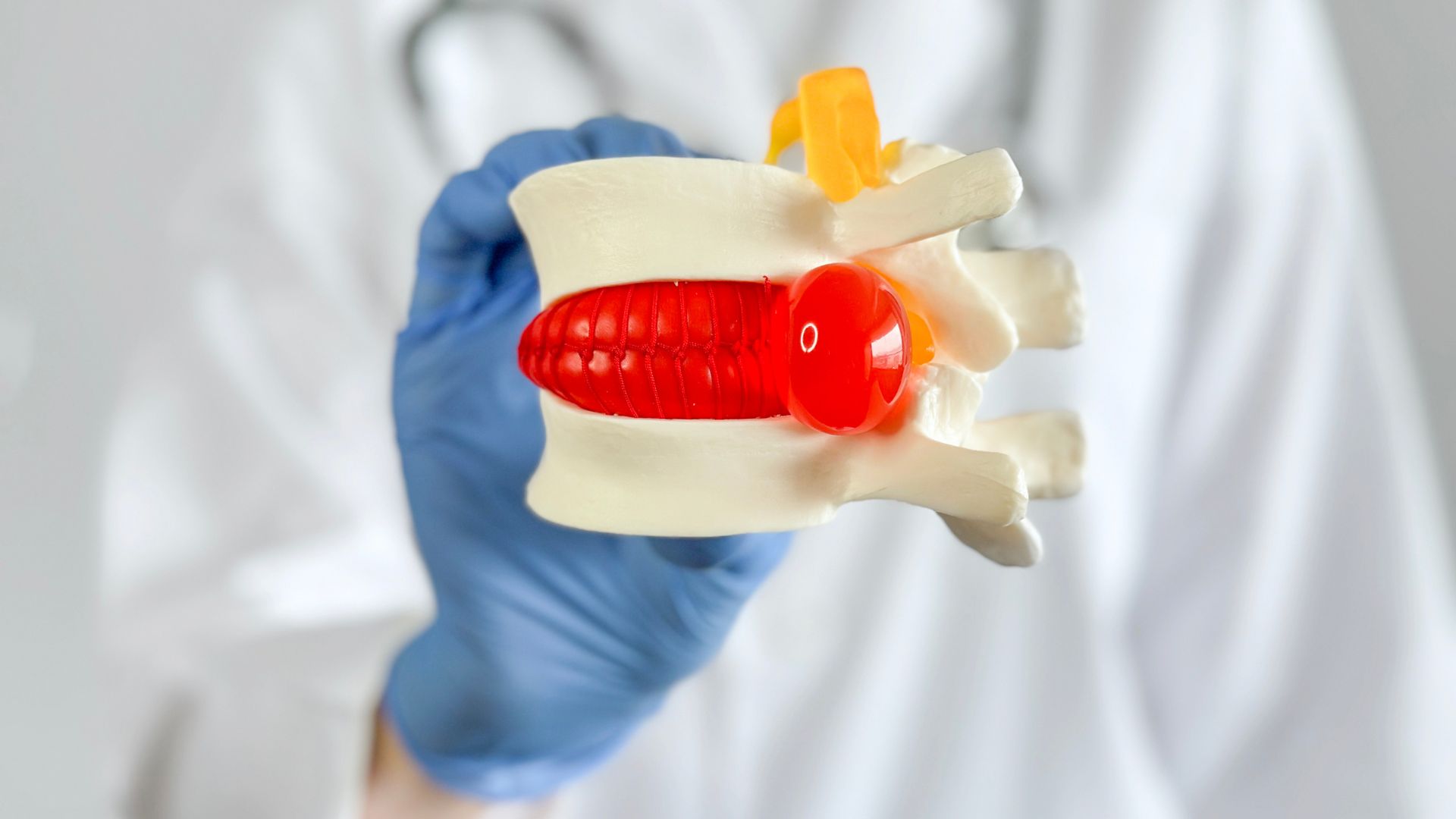
A bulging disc (opens in a new tab) happens when the disc extends beyond its normal boundary but stays intact. Think of it like a hamburger that’s slightly too big for its bun – it’s pressing outward but hasn’t broken open.
A herniated disc, also called disc herniation (opens in a new tab), is more serious. The outer layer of the disc tears, allowing the soft inner material, called the nucleus pulposus, to push through. This is what causes the nerve compression (opens in a new tab) and irritation that leads to sharp, shooting pain.
Both conditions affect the anatomy of the spinal canal and can press against nearby nerve roots, which is exactly what triggers those alarming symptoms spreading down into your legs or arms.
Common Bulging Disc and Herniated Disc Symptoms
Pain That Moves – and Doesn’t Stay Put
One of the clearest signs and symptoms of a disc problem is pain that travels. If you have a herniated disc in the lumbar vertebrae, you might feel a burning or stabbing sensation running down your leg – a condition known as sciatica. If the issue is in your cervical vertebrae (neck area), that radiating pain often travels into your arm and hand.
This radiating pattern is called radiculopathy, and it’s your nervous system’s way of telling you that a nerve is under pressure somewhere along the spinal cord pathway.
Numbness, Tingling, and Weakness
Paresthesia – that pins-and-needles or “asleep” feeling – is another hallmark symptom. It often affects the leg, foot, or toe in lumbar cases, and the arm or fingers in cervical cases.
Hypoesthesia, or reduced sensitivity to touch, can also develop. Over time, if the nerve compression syndrome goes unaddressed, you may notice real muscle weakness, making it harder to grip objects or walk normally.
When to Take It Seriously
Most back pain isn’t dangerous. But certain red flags warrant immediate attention from a medical doctor. These include loss of bladder or bowel control, fever paired with severe back pain, or the rapid onset of weakness in both legs.
If you notice any of these alongside your low back pain or neck pain, seek medical diagnosis right away.
What Causes Disc Herniation?
The intervertebral disc is mostly water when you’re young. Dehydration and natural aging cause the disc to lose height and flexibility over time, which increases its vulnerability to injury.
Risk factors include heavy lifting with poor spinal posture, repetitive twisting, obesity, and a sedentary lifestyle. Genetics also play a role – some people are simply more prone to disc disease than others.
Thoracic vertebrae disc problems exist too, though they’re far less common than lumbar or cervical cases.
How Is It Diagnosed?
Your provider will start with a physical examination to assess your range of motion, reflexes, and areas of tenderness. From there, magnetic resonance imaging (MRI) is typically the gold-standard tool for confirming where disc herniation is occurring and how much nerve involvement there is.
Neurology and orthopedic surgery specialists sometimes get involved in complex cases. For the vast majority of patients, however, surgery – including procedures like spinal fusion – isn’t necessary.
Non-Surgical Treatment Options That Actually Work
Conservative Care First
Most people with bulging or herniated discs respond well to conservative, non-invasive treatment. Physical therapy and targeted exercise help restore muscle support around the spine, reducing nerve irritation over time. Anti-inflammatory strategies, including nonsteroidal anti-inflammatory drugs (NSAIDs), corticosteroids, or muscle relaxants, are often recommended for short-term pain management.
Epidural steroid injections can also provide temporary relief for severe radiculopathy, but they don’t address the underlying structural issue.
Spinal Decompression Therapy
This is where Elite Chiropractic Rehab & Wellness (opens in a new tab) specializes. Spinal Decompression Therapy (opens in a new tab) is a non-surgical approach that gently stretches the spine to relieve pressure on compressed discs and affected nerves. By creating negative pressure within the disc, this therapy encourages the herniated material to retract and promotes improved circulation to the damaged area.
For patients dealing with chronic low back pain, sciatica, or spinal stenosis in Walnut Creek, this treatment offers a meaningful alternative to orthopedic surgery or neurosurgery.
Chiropractic Care and Adjunct Therapies
Chiropractic adjustments (opens in a new tab) improve spinal alignment and reduce the mechanical stress contributing to disc irritation. Combined with massage therapy, myofascial release, and cold laser therapy, patients often experience faster recovery and better long-term health outcomes.
The goal isn’t just pain relief – it’s restoring how your spine moves and functions so the problem doesn’t keep coming back.
Find Relief From Bulging or Herniated Disc Symptoms
Bulging and herniated disc symptoms don’t have to control your life. Whether you’re dealing with sharp low back pain, sciatica, or numbness radiating into your leg or arm, the right care plan can make a real difference.
If you’re in Walnut Creek and want a non-surgical path forward, learn more about how Spinal Decompression Therapy (opens in a new tab) at Elite Chiropractic Rehab & Wellness can help you get back to moving, living, and feeling like yourself again. Call us at 925-476-5070 to schedule your evaluation (opens in a new tab).